

Are you the photographer? Add your photo credit.Request removal


Sometimes referred to as inbreeding (or linebreeding) coefficient – this refers to how many times a common ancestor appears in a single horse’s pedigree. Generally speaking, going back around 12 generations is ideal as it gives you a big-picture glance that allows you to build a complete profile, but 8 generations works well too. Though this information isn’t the end-all be-all for determining the ideal mates for your mare or stallion, it is a great asset to have in your toolkit.
Defining saturation within a pedigree.
There are two ways to notate this, either by a simple percentage, or by writing it out as “3 x 3 x 4”. We’ll go in to how this is done, and having this information written out will be necessary in building your final percentages, so doing this as a first step is a great idea. Below is a visual representation of "3 x 3 x 4", as you can see, a single ancestor appears twice on the third generation, and a single time in the fourth generation of a single horse's pedigree.

We’re going to use Heart Stoppin for our examples, he’s got a pedigree absolutely packed with legendary horses, many of which unsurprisingly show up more than once. In deep-dive pedigree analyses, you would generally go back 12+ generations, but for this article, we’re going to abbreviate things a little and do the first 8 generations. We will also further abbreviate things and only highlight those horses that appear at least 3 or more times within those 8 generations.
Since we’ve already done the work to gather the pedigree notations for Heart Stoppin, let’s look at the horse that appears the most. In the case of Heart Stoppin, the horse that appears the most is the legendary Thoroughbred stallion, Three Bars.

Let’s dissect this first reference, so that the rest of the results are easier to understand. Anything with an “S” in front of it means that the horse appeared on the sire’s side of the pedigree, the “D” references the dam’s side. The number denotes the generation in which the horse appeared, and if that generation is noted more than once, it’s because the horse appeared more than once too.
So, to write this out in plain text, Three Bars appeared in the sire’s side of the pedigree at the 6th generation 3 times, the 7th generation 3 times, and twice in the 8th generation. On the dam’s side, Three Bars appeared 3 times, all in the 8th generation.
Make sense? Here are the remaining horses that appeared 3 or more times in Heart Stoppin’s pedigree in order of number of appearances.

King
S8 x S8 x S8 x S8 x D8 x D8

Zippo Pat Bars
S5 x S5 x S5 x D7 x D8

Poco Bueno
S7 x S7 x S8 x D8 x D8

Leo
S7 x S7 x S7 x D8 x D8
Civil Maid
S8 x S8 x S8
Doc Bar
S6 x D6 x D8
Dollie Pine
S5 x S5 x D7
Gossip Avenue
S8 x S8 x S8
Hobo Sue
S6 x S6 x D8
Joe Reed II
S8 x S8 x S8
Lightning Bar
S7 x D7 x D8
Little Chuck
S8 x S8 x S8
Little Fanny
S8 x S8 x S8
Luke McLuke
S8 x S8 x S8
Midway
S8 x S8 x S8
Poco Pine
S6 x S6 x D8
Pretty Boy
S8 x S8 x D8
Waggoner Mare
S8 x S8 x S8
Zippo Pine Bar
S4 x S4 x D6
It’s easy to see that there are saturations of specific lines that are more prevalent here than others. In 8 generations, Three Bars appears 8 times on the sire’s side, and another 3 times on the dam’s side. King appears 6 times, where Zippo Pat Bars, Poco Bueno, and Leo all appear 5 times. The remainder of horses that we found that appeared 3+ times are all in relation to those heavy hitters that we see appearing 8, 6, and 5 times.
How do we figure out the percentage of saturation?
Sometimes it can be deceiving when you see a lot of occurrences of an ancestor as to what the percentage of saturation is. There’s a really sound formula for determining percentage within the first 8 generations.
|
1st
50.00% |
2nd
25.00% |
3rd
12.50% |
4th
6.25% |
5th
3.125% |
6th
1.5625% |
7th
0.78125% |
8th
0.390625% |
With this formula in mind, let’s have a look back at the pedigree notations we gathered from Heart Stoppin. For each time the horse appears, take the value from the formula, and add those together.
Below are the cumulative numbers for each and every horse that we found with 3 or more occurrences in Heart Stoppin's pedigree:
| 1st | 2nd | 3rd | 4th | 5th | 6th | 7th | 8th | Total | |
| Zippo Pine Bar | - | - | - | 2x | 1x | - | - | - | |
|---|---|---|---|---|---|---|---|---|---|
| - | - | - | 12.5% | 1.5625% | - | - | - | 14.0625% | |
| Zippo Pat Bars | - | - | - | - | 3x | - | x1 | x1 | |
| - | - | - | - | 9.375% | - | 0.78125% | 0.390625% | 10.546875% | |
| Three Bars | - | - | - | - | - | x3 | x3 | x5 | |
| - | - | - | - | - | 4.6875% | 2.34375% | 1.953125% | 8.984375% | |
| Dollie Pine | - | - | - | - | 2x | - | x1 | - | |
| - | - | - | - | 6.25% | - | 0.78125% | - | 7.03125% | |
| Poco Pine | - | - | - | - | - | 2x | - | x1 | |
| - | - | - | - | - | 3.125% | - | 0.78125% | 3.90625% | |
| Hobo Sue | - | - | - | - | - | 2x | - | x1 | |
| - | - | - | - | - | 3.125% | - | 0.78125% | 3.90625% | |
| Doc Bar | - | - | - | - | - | 2x | - | x1 | |
| - | - | - | - | - | 3.125% | - | 0.78125% | 3.90625% | |
| Leo | - | - | - | - | - | - | x3 | x2 | |
| - | - | - | - | - | - | 2.34375% | 0.78125% | 3.125% | |
| Poco Bueno | - | - | - | - | - | - | x2 | x3 | |
| - | - | - | - | - | - | 1.5625% | 1.171875% | 2.734375% | |
| King | - | - | - | - | - | - | - | x6 | |
| - | - | - | - | - | - | - | 0.390625% | 2.34375% | |
| Lightning Bar | - | - | - | - | - | - | x2 | x1 | |
| - | - | - | - | - | - | 1.5625% | 0.390625% | 1.953125% | |
| Midway | - | - | - | - | - | - | - | x3 | |
| - | - | - | - | - | - | - | 1.171875% | 1.171875% | |
| Gossip Avenue | - | - | - | - | - | - | - | x3 | |
| - | - | - | - | - | - | - | 1.171875% | 1.171875% | |
| Luke McLuke | - | - | - | - | - | - | - | x3 | |
| - | - | - | - | - | - | - | 1.171875% | 1.171875% | |
| Civil Maid | - | - | - | - | - | - | - | x3 | |
| - | - | - | - | - | - | - | 1.171875% | 1.171875% | |
| Little Fanny | - | - | - | - | - | - | - | x3 | |
| - | - | - | - | - | - | - | 1.171875% | 1.171875% | |
| Joe Reed II | - | - | - | - | - | - | - | x3 | |
| - | - | - | - | - | - | - | 1.171875% | 1.171875% | |
| Little Chuck | - | - | - | - | - | - | - | x3 | |
| - | - | - | - | - | - | - | 1.171875% | 1.171875% | |
| Pretty Boy | - | - | - | - | - | - | - | x3 | |
| - | - | - | - | - | - | - | 1.171875% | 1.171875% | |
| Waggoner Mare | - | - | - | - | - | - | - | x3 | |
| - | - | - | - | - | - | - | 1.171875% | 1.171875% |
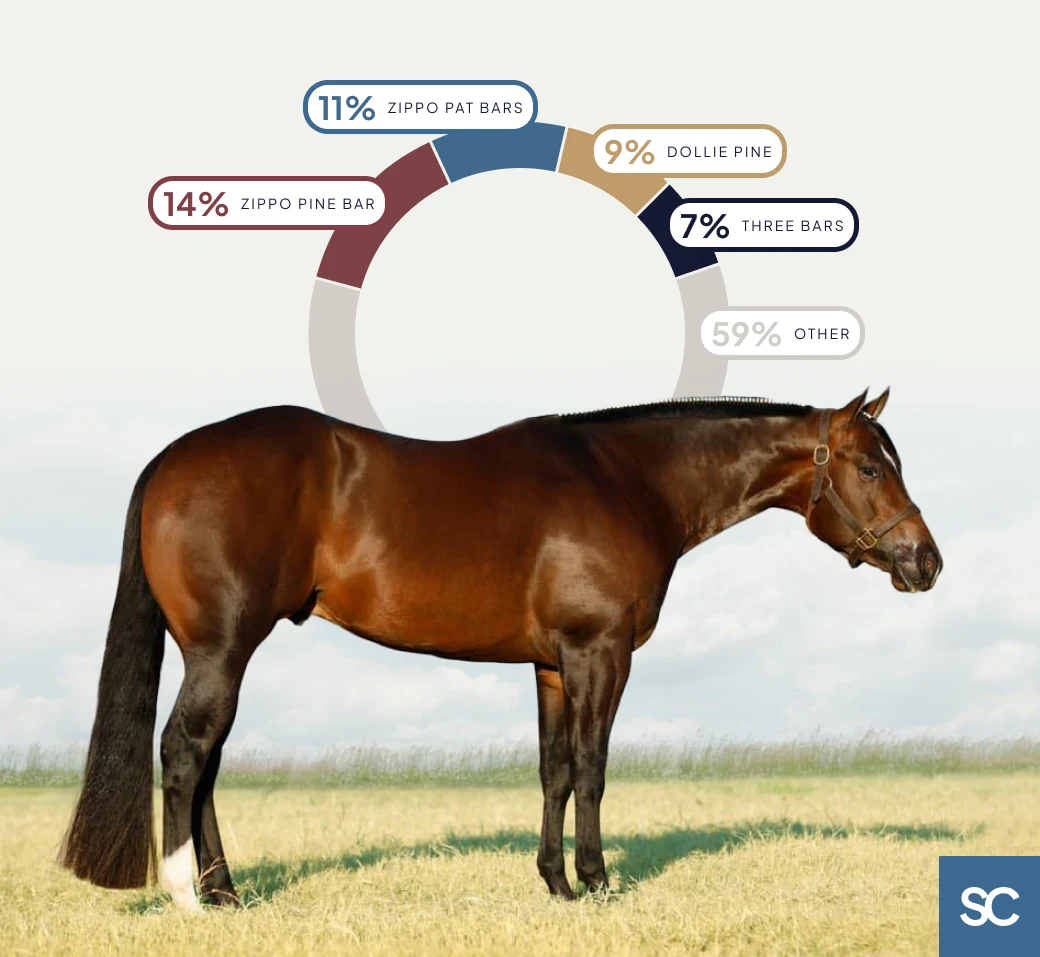
The fun takeaway from this is that though the numbers for Zippo Pine Bar are much lower (in occurrences), because of his location being closer up in the pedigree, he makes up 14.0625% of Heart Stoppin's pedigree. So with that cumulative knowledge, we would consider Heart Stoppin to be linebred to Zippo Pine Bar (Three Bars / Zippo Pat Bar), Poco Bueno, Leo, and King. The latter three don't carry near as much percentage due to their location further back, but they are noteworthy nonetheless due to their number of occurrences.

How does this affect type?
Percentage is a simple tool to help us understand the saturation of that genotype in a single horse. If we want to infuse more of that line and maintain the overall “type” you could cross back to other horses who also carry that line. However, if the horse has an over-saturation and an outcross is desired, it’s important to know line saturation of prospective mates. It’s also important to remember that when further linebreeding is desired, that the concentration of both negative and positive traits are going to increase. Which is to say, linebreeding and inbreeding are not fail-safe – you have just as much of a chance of producing negative outcomes as you do positive.
Key takeaways.
With all of this said, it’s absolutely imperative to take more into account than pedigree alone – that would be a misstep. However, this pedigree analysis can be considered a powerful tool in your toolkit that will allow you to understand how much certain lines are influencing your horse, and what areas you’d like to improve upon. Some mares need a shorter back, a lower hock, a longer neck – these are all very valuable things to be assessing in prospective mates. Equally, if not more important, is understanding performance and disposition. What are your goals with the prospective foal? Would you like that horse to have a future as a successful show horse, or a ranch horse that needs a great head on its shoulders? There is so much to take into consideration, and we truly hope that this article has helped you in understanding how to evaluate line saturation in your horses.
All of this is, of course, heavily reliant on genetics. A horse that has a high percentage of horses who are incredible performance horses is going to have more chances of passing that athleticism on (as well as negative aspects). The same theory goes for each of the pillars of a great horse Pedigree, Conformation, Disposition, and Performance.
Want to learn more or have questions? Looking for a complete analysis to be done on your mare or stallion? We can build a profile for you, for a nominal fee. Reach out to us on Facebook or send us a quick note to our email at hi@stallioncompare.com.